
Marcus Delaney, Staff Writer.
You are standing at the bathroom mirror at 7:10 in the morning, cap already off, and you are thinking about the meeting at noon, the humidity forecast, and whether today is the day the liner survives past lunch. Somewhere in a drawer there are four half-used tubes that promised 24-hour wear and gave you raccoon eyes by 3 p.m. The truth is less about the product and more about the surface you are putting it on and the order you do things in. A 2021 study in the International Journal of Cosmetic Science found that eyelid skin sheds oil at a markedly faster rate than the rest of the face, which is the single biggest reason waterproof formulas fail exactly where they are needed most. Get the prep and the technique right and even a modest formula holds. Get it wrong and the fanciest one still slides.
- Oil, not water, is the real enemy: waterproof liner resists moisture but most midday smudging traces back to natural lid oil breaking the seal, not tears or humidity.
- Thin, dry layers outlast thick, wet ones: a single heavy stroke takes longer to set and is more likely to transfer than two thin passes allowed to dry between coats.
- Removal technique determines next-day performance: rubbing to remove waterproof formulas weakens the lash line and lid skin over time, making future applications smudge faster.
Why Eyelid Skin Behaves Differently From The Rest Of Your Face
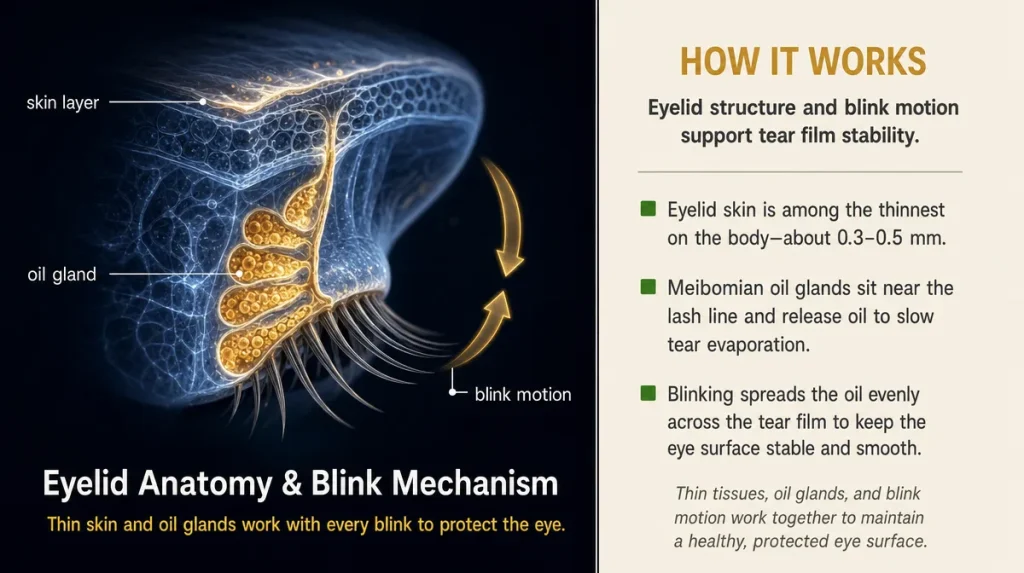
Eyelid skin is thinner than almost anywhere else on the body, closer in thickness to a sheet of tissue paper than to the skin on your cheek. It also sits over a muscle that moves thousands of times a day, blinking roughly 15 to 20 times a minute according to ophthalmology research cited by the Mayo Clinic in its patient guidance on blink rate and dry eye. That constant motion, combined with oil glands along the lash line, means the surface you are drawing on is never fully still and never fully dry.
Think of it the way you would think about writing on a balloon instead of a sheet of paper. The paper holds still. The balloon flexes, and anything drawn on it needs to flex too or it cracks and lifts.
This is why formula alone cannot solve smudging. The skin’s natural oil production, which increases with humidity and body heat, breaks down the film long before any water exposure would.
Prepping The Lid Before You Draw A Single Line
Most smudging complaints start before the liner ever touches the lid. Any residual moisturizer, sunscreen, or overnight eye cream left on the lid acts as a barrier that keeps liner from bonding to skin at all.
A simple pass with a dry cotton round removes surface oil without irritating the eye area. Some editors swear by a light dusting of translucent powder pressed onto the lid before lining, which absorbs oil and gives the pigment something drier to grip. This is an old theater-makeup trick, still used by professional makeup artists for stage lighting that never lets up.
Skip heavy eye cream on lining days, or apply it and give it several minutes to fully absorb. A 2022 consumer survey referenced by Allure found that nearly half of women who reported liner smudging admitted to applying it within minutes of moisturizing the eye area, before the product had time to sink in.
The Thin-layer Method That Actually Holds
The instinct with waterproof formulas is to press hard and go for full opacity in one stroke, since the tube promises long wear. That instinct works against you.
A single thick line takes longer to dry, which means more time for it to transfer to the upper lid crease or smear on a finger swipe. Two thin layers, each allowed 15 to 20 seconds to set before the next, dry harder and crack less.
Draw the line in short segments rather than one continuous sweep. Start from the outer corner and work inward in small strokes, which gives you more control near the lash line where skin moves most. Let each segment dry before connecting it to the next. This is the same logic behind painting a fence in thin coats rather than one heavy one: thin coats cure properly, thick ones stay tacky underneath even when the surface looks dry.
The Mistakes Almost Everyone Makes Without Noticing
The most common error is touching the line while it is still setting, to fix a wobble or check for symmetry. That fingertip contact, even light, reopens the film before it has cured and often causes the exact smudge the person was trying to prevent.
Another frequent mistake is applying liner over an eye that is not fully done with its shadow or concealer. Powder shadow particles that fall onto a wet line create a gritty, uneven edge that then flakes throughout the day.
A third mistake is skipping a set spray or setting powder entirely because the formula says waterproof on the label. Waterproof refers to resistance against water and tears, not against oil transfer, so a light dusting of translucent powder over a finished line, using a small brush and a light hand, adds meaningful hold.
Reading The Label Without Falling For The Marketing
Terms like long-wear, smudge-proof, and waterproof are not regulated the way sunscreen SPF numbers are, so two products can carry the same claim and perform very differently. What tends to matter more than the marketing language is the base of the formula.
Water-based liquid liners generally dry to a thinner, more flexible film. Formulas built on silicone or wax bases tend to sit on the surface longer before setting fully, which can mean more transfer risk in the first hour after application but often better flexibility once cured.
A felt-tip or brush-tip applicator does not change wear time on its own. It changes how easily you can control line thickness, which indirectly affects wear because thinner, more even lines hold up better than thick, uneven ones regardless of formula.
A 30-Second Self-test Before You Leave The House

Once your line is finished and set, press a clean tissue lightly against the lash line, without dragging it. If pigment transfers onto the tissue, the line has not fully cured and needs another minute before you touch anything, including sunglasses or a face mask.
Next, blink rapidly ten times, the way you would if something got in your eye. Watch a hand mirror at a downward angle to see if any color has migrated into the crease. Migration at this stage usually means too much product was applied in one pass rather than a formula failure.
This two-part check takes under a minute and catches most failures before they become an afternoon problem, rather than discovering the issue at 2 p.m. in an office bathroom.
Why Daytime Humidity Changes The Rules
East Coast summers bring humidity that keeps skin slightly damp most of the day, which slows the initial set time for any liquid liner and extends the window where a line can smudge before it fully cures. Dry winter air, especially indoors with heating running, has the opposite effect: liner sets faster but can also flake at the edges if the surrounding skin is dehydrated.
Adjusting for season matters more than switching formulas. In humid months, allow extra drying time between layers and consider a light powder set even with formulas that do not usually need one. In dry winter months, a very thin layer of eye cream applied the night before, fully absorbed by morning, keeps the lid from flaking under the line.
This is less about buying a summer liner and a winter liner and more about adjusting technique to the air you are actually applying it in.
Taking It Off Without Undoing The Good Work
How you remove waterproof liner affects how the next application performs. Rubbing or scrubbing to break down a stubborn formula stresses the thin skin along the lash line and can lead to micro-irritation, which in turn makes the surface less even for the next day’s line.
A gentle, oil-based remover on a cotton pad, pressed against closed lids for ten seconds before wiping in one direction, breaks down waterproof pigment far more effectively than repeated rubbing. The American Academy of Dermatology’s general guidance on eye makeup removal recommends this press-and-hold approach specifically to reduce mechanical stress on the eyelid.
Skipping removal entirely, even for one night, tends to make the following day’s application uneven, since old pigment residue mixed with overnight oil creates a patchy base for new liner to sit on.
Key Takeaways
The formula matters less than most labels suggest. Oil, not water, is what actually breaks down a waterproof line over the course of a day, and thin, patient layers beat one thick stroke every time. Prep the lid, let each pass dry, resist the urge to touch it while it sets, and remove it gently at night so the next morning starts from an even base.
A Quick Checklist Before You Walk Out The Door
- Lid free of leftover moisturizer or sunscreen residue
- Line applied in two thin passes, not one heavy one
- Each segment given 15 to 20 seconds to set before connecting
- Tissue press test shows no transfer
- Ten rapid blinks show no migration into the crease
- Light translucent powder set over the finished line, if humidity is high
- Remover applied with a press-and-hold motion at night, not a rubbing motion
This article is for general information and does not replace advice from a dermatologist or eye care professional.
Individual results and wear time vary by skin type, climate, and application method.