
Rachel Kessler, Beauty Editor.
You spray it at 7 a.m. standing in front of the bathroom mirror, and by the time you’re unlocking your desk at noon, you can’t smell it anymore. So you dig through your bag for the travel-size bottle you bought at Sephora on a whim, and you spray again, and by 3 p.m. you’re wondering if your nose has just gone numb or if the perfume genuinely disappeared. Both things can be true, and figuring out which one is happening to you is the first step toward a routine that holds up.
Here is the useful fact most people never learn: your nose adapts to a scent you’re wearing within minutes, a phenomenon perfumers call olfactory fatigue. The people around you can usually still smell it fine. That doesn’t mean longevity isn’t real. It means the fix usually isn’t more spray, it’s a different starting point.
- Skin type changes how long a scent reads on you, since drier skin holds fragrance less than skin with more natural oil, so the same bottle can behave differently on two people.
- Where you spray matters more than how much, because pulse points and clothing fibers hold onto fragrance oils very differently.
- Layering a matching body product roughly doubles perceived staying power in informal wear tests, without needing a heavier concentration of perfume.
Why The Same Bottle Smells Different On Everyone
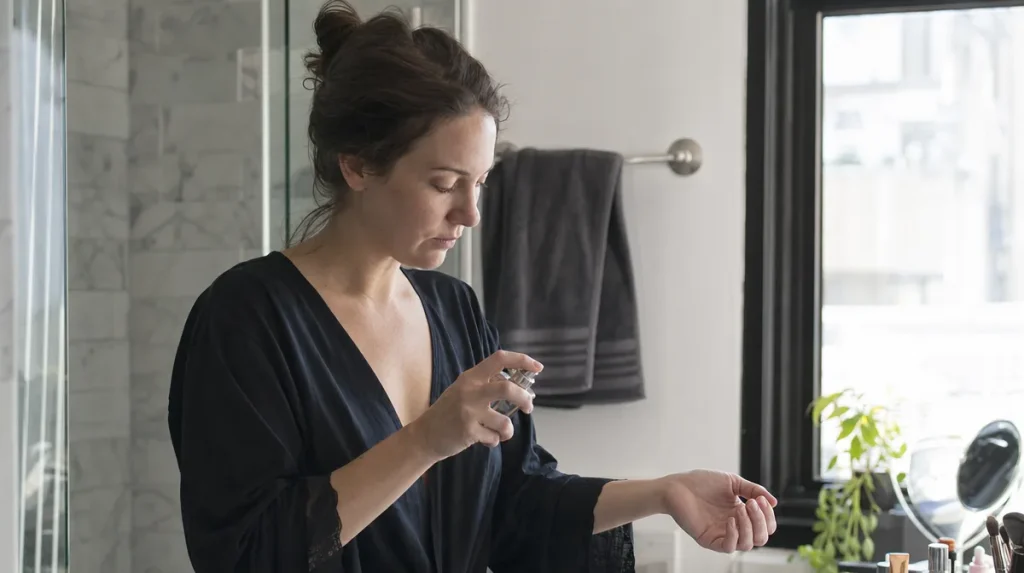
Perfume is not paint. It doesn’t sit on top of skin the way a coat of nail polish sits on a nail. It blends with your skin’s own oils and warmth, and that’s exactly why two people can spray the identical eau de parfum and end up with two different experiences by lunchtime.
Drier skin has less natural oil to hold onto fragrance molecules, so scent tends to fade faster and read lighter. Oilier skin acts more like a sponge, and can actually amplify certain notes, sometimes making a fragrance smell stronger or slightly different than it does on a paper blotter in a store.
Think of it the way a wool sweater and a cotton t-shirt hold onto woodsmoke differently after a bonfire. Same smoke, same amount of time near the fire, very different results depending on the material.
This is why a fragrance that a friend swears is her holy grail scent might feel underwhelming on you within two hours. It isn’t a flaw in the perfume or in your skin. It’s a mismatch worth knowing about before you decide a bottle simply doesn’t last.
Finding Your Skin’s Baseline Before You Blame The Bottle
Before assuming a fragrance is weak, it helps to run a quick, honest self-test. Spray it once on clean, bare skin, on the wrist, and do nothing else: no lotion first, no layering. Check back at the one-hour mark, then again at four hours, without spraying anything else in between.
If you can’t smell it at all by hour four but a friend can when she leans in, that’s normal olfactory fatigue, not fading. If neither of you can detect it, the issue is likely your skin’s dryness or your body chemistry, not the product.
Run this test in the morning on a day when you haven’t just showered with heavily scented soap, since competing scents from shower gel or body wash muddy the read. A 2019 study in the International Journal of Cosmetic Science noted that background scent from other personal care products is one of the most common confounders when people evaluate fragrance longevity at home.
Do this once, on a normal day, not a gym day or a day you’re sweating heavily, and you’ll have a real baseline to work from instead of guessing.
Where You Spray Changes What Survives The Day

Most people spray perfume the way they were taught as teenagers: a spritz on each wrist, rubbed together, maybe one on the neck. That rubbing motion is worth unlearning. Friction generates a small amount of heat and breaks down the more delicate top notes of a fragrance faster, which is part of why a scent can seem to vanish within the first thirty minutes.
Pulse points, the inner wrists, the base of the throat, behind the ears, work well because they run slightly warmer, and warmth helps fragrance diffuse into the air where you and others can actually smell it. Hair and clothing fibers, by contrast, hold fragrance oils for much longer than skin does, sometimes for a full day, because fabric doesn’t shed and regenerate the way skin does.
A simple household comparison: think about how a scented candle’s smell lingers in curtains long after the candle itself is out, while it fades from your hands almost immediately after you touch the wax. Fabric traps scent molecules in a way that skin simply can’t.
A practical routine, then, spreads a light layer across a few pulse points and adds one spray to the inside hem of a scarf or the lining of a coat, never directly onto silk or delicate fabric that could stain.
The Layering Habit That Actually Extends Wear Time
Fragrance houses have sold matching body lotions and shower gels for decades, and it’s easy to write that off as an upsell. But there’s a real mechanism behind it. A scented or unscented moisturizer applied before perfume gives the fragrance molecules something to bind to, since dry skin has fewer natural oils to hold onto scent on its own.
In informal wear tests conducted by fragrance houses and reported in trade press, testers who applied an unscented moisturizer before spraying reported detectable scent lasting close to twice as long as on bare, dry skin. The moisturizer isn’t adding fragrance, it’s giving the fragrance a better surface to sit on, the way a primer helps paint adhere evenly to a wall instead of soaking unevenly into bare drywall.
This doesn’t require buying a matching lotion. Any basic, fragrance-free body lotion applied right after a shower, while skin is still slightly damp, does the job. The order matters: moisturizer first, on damp skin, then perfume a minute or two later once the lotion has mostly absorbed.
Skip this step in humid weather, though. East Coast summers already keep skin naturally more hydrated, and adding a heavy lotion underneath can make a fragrance feel cloying rather than lasting.
Why Dry Winter Air Seems To Eat Your Perfume
If you notice your favorite scent lasting shorter in January than it did in July, that’s not in your head. Indoor heating strips moisture from the air and from your skin, and dry skin holds fragrance less effectively for the reasons already covered above.
The fix isn’t a stronger spray, it’s compensating for the dry air itself. A hand cream or body lotion applied more generously in winter months, paired with a slightly lower reliance on rubbing-in application, tends to close most of the gap.
Some people also notice that scents they consider warm or spicy actually perform better in cooler, drier months, since heavier notes read as heavy rather than warm once summer humidity is added to the mix. That’s a preference question more than a longevity one, but it explains why a bottle that felt perfect in October can feel like too much by July.
Reading A Fragrance Concentration Label Without Getting Fooled
Eau de parfum, eau de toilette, and parfum extrait all describe roughly how much concentrated fragrance oil is diluted into the bottle, not how good the scent is. Eau de parfum generally sits at a higher concentration than eau de toilette, which is part of why it’s marketed as longer-lasting.
But concentration alone doesn’t guarantee wear time. A well-formulated eau de toilette applied correctly, on slightly moisturized skin, at pulse points, can outlast a poorly applied eau de parfum sprayed once and rubbed into dry wrists. The label tells you about the formula. It doesn’t tell you about your skin or your routine.
What’s worth checking, according to guidance published by the American Academy of Dermatology on fragrance and sensitive skin, is the ingredient list for alcohol content and any specific allergens if you have a history of skin irritation, since higher-alcohol formulas can dry out sensitive skin over repeated daily use. That’s a skin health note more than a longevity one, but the two often intersect for people who apply fragrance directly to already dry or reactive skin.
The Reapplication Mistake That Shortens A Bottle’s Life Without Extending Your Day
When a scent seems to fade by midafternoon, the instinct is to reach for a heavier reapplication, often two or three sprays instead of the original one. This usually backfires in a specific way: newly applied top notes sit on top of the day’s already-worn base notes, and the mix can smell muddled or simply stronger without smelling fresh.
A lighter touch works better. One spray to a clean pulse point, ideally one that wasn’t sprayed that morning, refreshes the scent without layering conflicting notes. Carrying a travel atomizer, widely sold at Ulta Beauty and Sephora in the 1 to 2 fl oz range, makes this practical without hauling a full bottle in a bag.
It’s also worth noting that what feels like fading by 2 p.m. is sometimes just olfactory fatigue again, not an actual loss of scent. Before reapplying, it can help to step outside for fresh air for a minute or ask someone else if they can still smell it. Often the answer is yes.
Storage Habits That Quietly Shorten How Long A Bottle Performs
A fragrance sitting on a sunny windowsill or a steamy bathroom shelf breaks down faster than most people realize. Heat, light, and humidity all degrade the fragrance oils over time, which means a bottle that once lasted eight hours might genuinely perform worse a year later, not because you’re using it wrong but because the product itself has changed.
A cool, dark drawer or a closet shelf keeps a bottle stable far longer than a bathroom counter, even though the bathroom is the more convenient spot for a morning routine. If the liquid inside has visibly darkened in color compared to when you bought it, that’s usually a sign the formula has begun to break down, and longevity will suffer regardless of how you apply it.
This matters most for anyone who bought a large bottle during a Black Friday sale and expects it to perform the same in year two as it did in month one. Fragrance doesn’t spoil the way food does, but it does drift.
Key Takeaways
A fragrance routine that actually holds up rarely comes down to buying a stronger bottle. It comes down to skin prep, placement, and honest expectations about how your own nose works.
Moisturized skin holds scent longer than dry skin. Pulse points and fabric hold fragrance differently, and both have a place in a daily routine. Reapplying lightly beats reapplying heavily, and where you store a bottle affects how well it performs a year from now.
A Simple Daily Checklist
- Apply an unscented lotion to damp skin right after showering, before spraying perfume.
- Spray one or two pulse points without rubbing the skin together afterward.
- Add one light spray to a scarf, coat lining, or hair rather than more sprays on skin.
- Carry a small travel atomizer for a single midafternoon refresh instead of multiple heavy sprays.
- Store the bottle in a drawer or closet, away from sunlight, heat, and bathroom humidity.
- Adjust expectations seasonally: expect faster fading in dry winter air, and lighter wear in humid summer months.
This article is for general information and does not replace advice from a dermatologist or fragrance professional.
Individual results vary based on skin type, climate, and application habits.