
Rachel Kessler, Beauty Editor.
Most people do not have a bad flat iron. They have a bad relationship with the one they own.
You bought it after reading reviews, maybe during a Black Friday sale, and the first few weeks it worked beautifully. Then the results got inconsistent: smooth on Tuesday, frizzy by noon on Thursday, a crimp mark near your part no matter how many times you go over it. The instinct is to blame the tool and start browsing for a replacement.
Before you do that, it helps to know one fact that most packaging never mentions: a flat iron reaching its set temperature and your hair actually absorbing that heat are two different events, separated by time and technique. The plates can read 380 degrees while the strand between them is still closer to room temperature, because hair is a poor conductor and a single fast pass does not give heat anywhere to go. That gap, more than the price tag on the box, explains most of the uneven results people blame on their tools.
This guide walks through the technique adjustments that make the iron you already own perform closer to its actual capability, without spending another dollar.
- Heat needs time, not just temperature: a hot plate moved too quickly barely touches the hair shaft before it has passed.
- Section width decides smoothness more than brand: sections wider than the plate guarantee missed spots no matter how many passes you do.
- Humidity undoes technique, not the other way around: a flawless pass in a steamy bathroom can relax within the hour, and that is physics, not failure.
Why The Same Iron Gives Different Results On Different Days
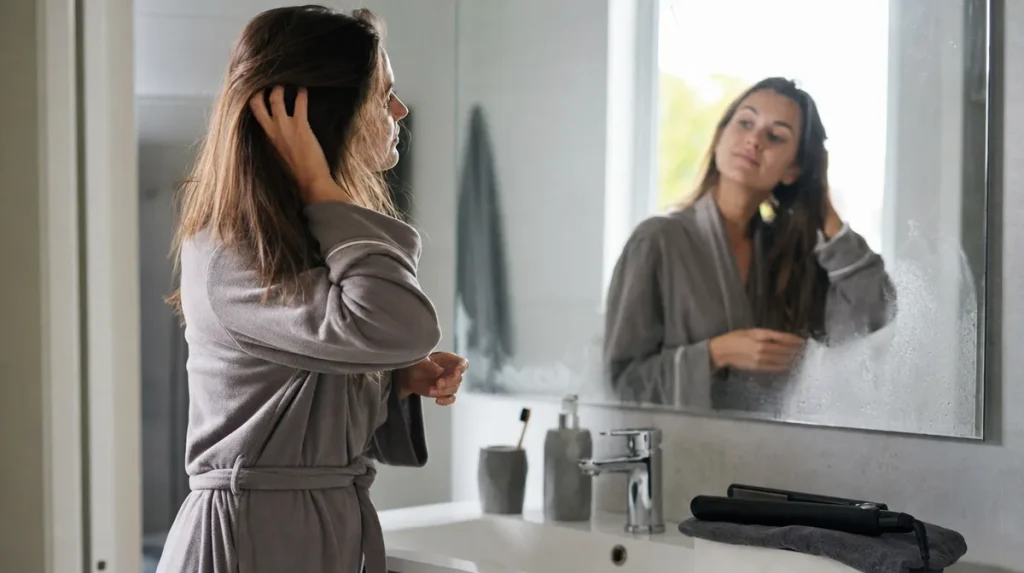
Hair is a protein fiber held in shape by hydrogen bonds, the weakest and most temporary of the bonds that give hair its structure. Heat and tension break those bonds long enough to reset them in a new, straighter position. The moment the hair cools, the bonds lock back in.
The problem is that hydrogen bonds are reopened by water, including the water vapor floating in humid air. That is why a style that looked glassy when you left the house can soften by the time you reach the subway platform on a muggy day, while the same technique holds for hours in a dry, heated apartment in January.
Think of it the way a dry cleaner thinks about a shirt. A crisp crease holds in a closet but wilts the moment you step into a steam room. Your flat iron is not failing. It is being asked to fight moisture it cannot control.
Knowing this changes what you troubleshoot. If results are inconsistent only on humid days, the fix is a lightweight anti-humidity product and possibly a cooler, slower pass, not a new iron.
Sectioning: The Step That Decides Everything Before Heat Gets Involved
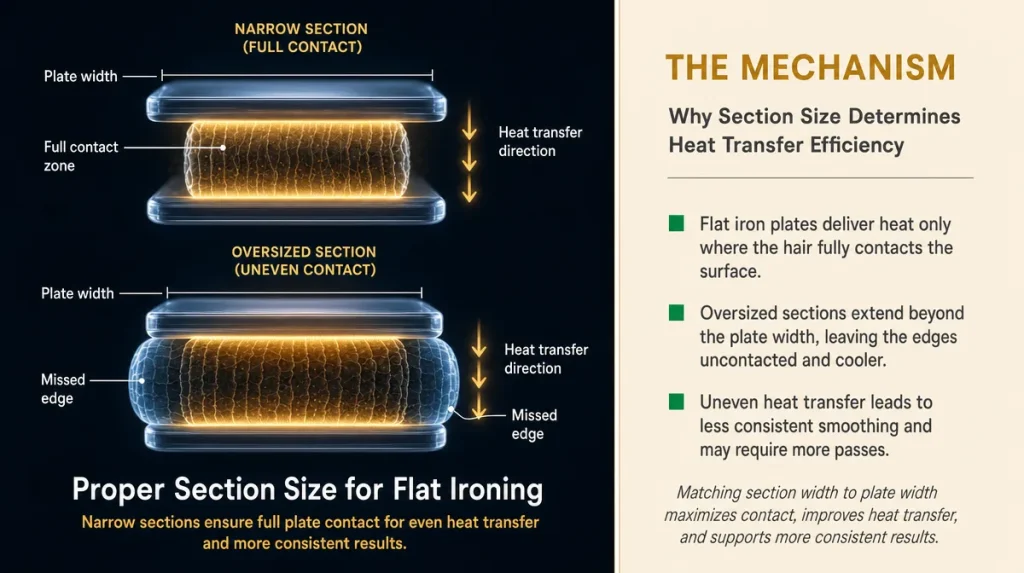
Most uneven results trace back to a step that happens before the iron ever gets hot: how the hair is divided.
A section should never be wider than the plates themselves. If the iron has one-inch plates and you grab a two-inch chunk, the outer edges never make full contact with the heated surface. Those edges are the strands that frizz first and curl back by afternoon.
Work from the nape up, clipping away everything you are not currently styling. Within each horizontal row, take sections no wider than the plate and no thicker than about a quarter inch. It feels slower. It is slower, by several minutes. But it is the difference between a style that needs touch-ups within the hour and one that holds through dinner.
A quick self-test: after you finish a section, run two fingers down it. If you can feel a ridge of hair that visibly did not get flattened, the section was too wide. Narrow it next time and compare.
Matching Temperature To Texture, Not To Habit
A common mistake is setting the dial to the highest number the first week and never touching it again. Fine or color-treated hair generally needs far less heat to reshape than coarse or very curly hair, because thinner strands have less mass to warm through.
As a general guide, the American Academy of Dermatology’s public guidance on heat styling notes that lower settings combined with a heat protectant reduce the risk of damage compared with maximum heat used briefly. Many stylists translate that into rough bands: finer hair styled closer to the lower end of a flat iron’s range, medium texture in the middle, and coarse or very curly hair toward the higher end, always starting low and testing first.
The self-test for this is simple and takes under a minute. Take one small section at your usual setting and run the iron through once, slowly. If it takes two or three repeated passes to see any change, the setting is likely too low for your texture. If you see a faint sizzle or your hair feels dry and brittle afterward, it is too high. Adjust in small increments rather than jumping straight to maximum, and give the plates a minute to stabilize after each change before testing again.
One Slow Pass Beats Five Rushed Ones
There is a reflex, when a style is not taking, to run the iron back over the same section again and again. It feels productive. It is usually the opposite of helpful.
Each additional pass over already-styled hair adds heat exposure without adding much new structural change, since the hydrogen bonds already reset on the first proper pass. What repeated passes do add is moisture loss from the hair shaft, which over weeks shows up as dryness, flyaways, and a dull, straw-like texture rather than a smooth one.
A 2019 study in the International Journal of Cosmetic Science comparing single and repeated heat styling passes on swatches found that cuticle damage, visible under microscopy as lifted or missing scales, increased notably with each additional pass at the same temperature, while the straightening effect itself showed little added benefit after the first thorough pass.
The better habit is one slow, steady pass, taking about three to five seconds to travel the length of a section, rather than four fast ones. If the result is not smooth after that single pass, the fix is usually a narrower section or a few degrees more heat next time, not more repetition at the same settings.
Angle And Tension Without Extra Heat
A flat iron held flat against the head, parallel to the floor, tends to crease hair where the plates meet the scalp. Tilting the iron slightly, so the front edge angles downward along the direction the hair will travel, lets the plates glide rather than pinch.
Tension matters as much as angle. Pulling a section taut with the free hand while the iron moves gives the heat a straight, even surface to work across, the way a tablecloth pulled smooth irons out more evenly than one left loose and bunched. Hair held slack tends to develop small waves or kinks precisely where the tension slackened.
A practical way to check tension without a mirror: if your wrist feels like it is fighting the iron, or the pass feels jerky, the section is likely loose. A properly tensioned section glides with light, even resistance, almost like pulling a ribbon flat.
For anyone working with layers or face-framing pieces, rotating the iron a quarter turn at the very end of a pass, a technique borrowed from blowout styling, can prevent the flipped-out ends that otherwise need a second pass to fix.
What Actually Protects Hair, And What Is Just Packaging Language
Heat protectant sprays and creams are not interchangeable with ordinary styling products, even when the bottles sit side by side on a drugstore shelf. The ingredients that matter are typically silicones or specific polymers designed to form a thin, even film over the hair shaft that slows heat transfer and reduces moisture loss during styling.
A 2023 study in the Journal of Cosmetic Science testing several heat protectant formulations under controlled flat iron use found that swatches treated with polymer-based protectants retained visibly more protein content after repeated heat exposure than untreated swatches, though results varied by formulation and hair type.
What does not reliably help is shine serum or oil applied right before styling with no protectant underneath. Oils can smoke or even scorch at flat iron temperatures, and a glossy finish on the bottle has no bearing on whether a product was formulated to withstand heat.
The practical rule: apply a heat protectant to damp or fully dry hair before styling, let it distribute evenly with a wide-tooth comb, and save shine serums for after the iron has cooled the hair back down, applied sparingly to the mid-lengths and ends only.
Reading Your Results And When To Judge Them
It is tempting to judge a style the moment the iron leaves the last section, but hair needs to fully cool to room temperature before the new hydrogen bonds finish setting. Touching or styling it further while still warm can undo work that looked finished a minute earlier.
The more honest test is the 48-hour check. Style as usual, then notice how the hair behaves the next morning and the morning after, without reapplying product. If it holds its shape with only light frizz at the crown, the technique is working for your hair and your climate. If it falls flat or frizzes heavily within a few hours, the cause is more often humidity or product buildup than the iron itself.
Climate genuinely changes the math here. Humid East Coast summers reopen hydrogen bonds faster than a dry winter indoors with the heat running, so the same technique that looks flawless in February may need a lighter touch of anti-humidity product in July. This is not a sign of doing something wrong, just a seasonal adjustment worth building into the routine rather than fighting.
Keeping The Plates Themselves Doing Their Job
Product residue, mostly silicone and wax from styling sprays and serums, builds up on flat iron plates over weeks of use, even when the surface looks clean to the eye. That film acts as insulation, meaning the iron has to run hotter to deliver the same heat to the hair, which is one reason a once-reliable tool can start to feel weaker over time without actually losing function.
Wiping the plates with a damp microfiber cloth after they have fully cooled, roughly once a week with regular use, removes most of this buildup. For more stubborn residue, a small amount of rubbing alcohol on the cloth works on most ceramic and titanium plate coatings, though it is worth checking the manufacturer’s care instructions first since some coatings are more sensitive than others.
A simple way to notice buildup before it becomes a problem: run a clean white cotton pad over cooled plates. Any gray or waxy residue transferred onto the pad means it is time to clean. This five-minute habit, done consistently, often restores performance that felt like it required a replacement tool.
Key Takeaways
Technique changes results more reliably than a new purchase, and most of the fixes above cost nothing.
Section width, pass speed, temperature matched to texture, and a genuine heat protectant account for the overwhelming majority of the difference between a smooth style and a frustrating one. Climate and plate cleanliness explain most of what is left.
A Quick Checklist Before Your Next Style
- Keep sections no wider than the iron’s plates.
- Match temperature to your actual texture, tested low and raised gradually.
- Use one slow pass of three to five seconds rather than several fast ones.
- Pull sections taut and angle the iron slightly rather than holding it flat.
- Apply a real heat protectant, not just a shine serum, before styling.
- Judge results after 48 hours, not immediately.
- Wipe plates weekly to remove residue buildup.
This article is for general information and does not replace advice from a dermatologist or stylist.
Individual hair results vary by texture, product history, and climate.