
Rachel Kessler, Beauty Editor.
It happens around two in the afternoon. You catch your reflection in a car window or a bathroom mirror at work and your foundation has slid into your pores, your concealer has crept into the fine lines under your eyes, and the setting spray you paid good money for feels like it did nothing at all. The bottle promises all-day wear, but your face has other plans.
Most people treat setting spray as an afterthought, a last spritz before walking out the door. That is backwards. A 2021 survey cited by Byrdie found that the majority of women who wear makeup daily reapply at least once before 5 p.m., and a large share said their biggest frustration was oil breakthrough on the T-zone. The fix is rarely the spray itself. It is almost always the steps before and after it.
This guide walks through what setting spray actually does to your skin, how to build a routine around it that holds up through a humid commute or a dry, heated office, and how to tell a product that is working from one that is just evaporating.
- Setting spray works by forming a thin polymer film, not by “locking in” makeup chemically, so how you prep skin matters more than which bottle you buy.
- Application distance and layering order matter more than ingredient lists, since most sprays fail from technique, not formula.
- Climate changes the routine: humid days call for a lighter hand and oil control first, dry winter air calls for hydration before any spray touches your face.
What A Setting Spray Is Actually Doing To Your Skin
Think of setting spray the way you think of a coat of clear varnish on a wood table. The varnish does not change the wood underneath, it just sits on top and slows down water, scuffs, and fingerprints from reaching it. A setting spray works in a similar way on makeup: it leaves behind a very thin film, usually from a polymer or a film-forming agent, that sits over your foundation and powder and slows the rate at which oil and sweat break through.
It does not change your skin’s oil production. It does not shrink pores. A 2019 formulation review in the Journal of Cosmetic Science noted that most setting sprays rely on acrylate copolymers or similar film formers suspended in a fast-evaporating base, often water with a small amount of alcohol. Once the liquid evaporates, the film is what remains.
This matters because it explains why the same spray performs differently on two people. If your skin produces oil quickly, the film has more to hold back and will visibly break down sooner. If your skin is already dry or dehydrated, the film can sit on top of flaking patches and make them more visible, not less.
Understanding this mechanism changes how you shop and how you apply. You are not looking for a magic ingredient. You are looking for a film that suits your skin’s actual behavior that day.
Prepping Skin So The Spray Has Something To Hold Onto
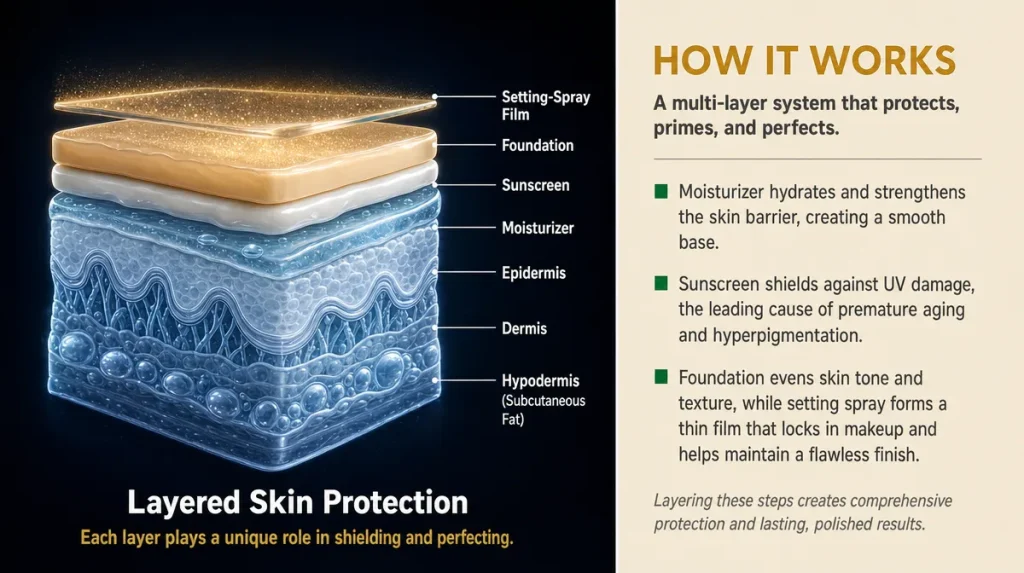
A setting spray cannot fix what happened before it. If your moisturizer has not absorbed, or your sunscreen is still sitting wet on the surface, the spray will slide right off with everything else.
The practical method: moisturize at least five minutes before you start makeup, long enough for the product to settle rather than sit wet. In humid weather, a lighter lotion texture works better than a heavy cream, since a heavy layer underneath becomes the first thing to break down in heat. In dry winter months, when indoor heating strips moisture from the air, skip ahead on hydration rather than skimping, because flaky patches telegraph through every layer applied on top, spray included.
One mistake nearly everyone makes: applying setting spray directly after powder without letting the powder settle into the skin for a minute. The spray dissolves loose powder that has not had time to bind, which is part of why some people say their foundation goes patchy with the very product meant to protect it.
Self-test: press a clean tissue lightly on your forehead and nose right after finishing your base makeup, before any spray. If the tissue picks up visible oil already, your skin needs a mattifying step first, not more spray later.
The Distance And Motion That Actually Make A Difference
Most people hold the bottle too close and spray too much in one spot. The result is a wet patch that beads and runs, dragging foundation with it rather than setting it.
The method dermatology-adjacent beauty educators consistently describe, including guidance referenced by Allure, is to hold the bottle roughly eight to ten inches from the face and apply in a loose X or T motion, crossing the forehead, cheeks, and chin in one continuous sweep rather than stopping to spray any single area directly. Two light passes beat one heavy one.
The mistake to watch for: spraying in short, close bursts aimed at the nose or chin, which are exactly the areas most prone to oil. Concentrated spray there oversaturates the makeup and can cause it to separate rather than set.
After spraying, resist the urge to blot or touch the face for about thirty seconds. The film needs that window to begin setting. Touching it mid-dry smears the very layer you just applied.
Reading Ingredient Lists Without Getting Lost In Marketing Language
Bottles use words like “hydrating,” “matte,” and “24-hour” freely, and those words are not regulated the way drug claims are. What actually tells you something is the base of the formula.
A spray listing alcohol denat. high on the ingredient list will dry down fast and feel weightless, which suits oily or humid-climate skin but can feel tight on already dry skin. A spray built on a glycerin or aloe base will feel more cushioned and is generally kinder to dry or sensitive skin, though it may take longer to fully set and can feel slightly tacky in humidity.
Film-forming ingredients to recognize on a label include VP/VA copolymer and various acrylates copolymers. Their presence is what gives a spray its hold, not the marketing phrase next to the price.
What matters far less than the label suggests is fragrance and color. These affect how pleasant the spray feels to use but do nothing for wear time. A 2020 consumer-testing summary published by Good Housekeeping’s product-testing lab noted that wear-time performance correlated far more closely with film-forming agent concentration than with any marketed “finish” claim on the bottle.
Matching Your Routine To The Season, Not The Bottle
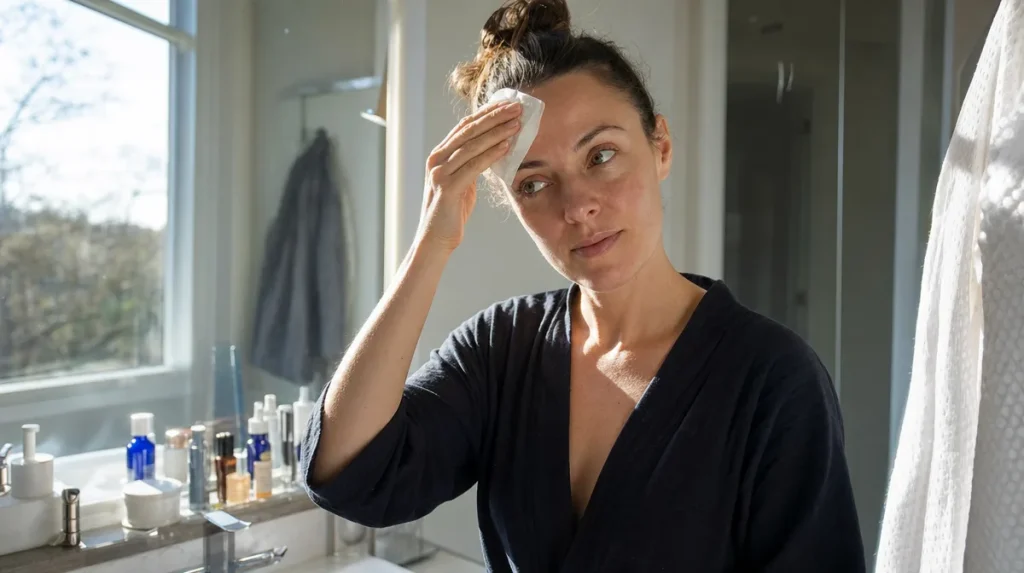
A spray that performs beautifully in a dry January office can fail completely on a humid July commute, and that is not a flaw in the product. It is a mismatch with the air around it.
In humid conditions, common on the East Coast through summer, skin already has more moisture competing with the setting film, and sweat breaks down a film faster regardless of formula. The practical adjustment is to mattify first, with a lightweight powder in the T-zone, then spray in thinner passes and let each one dry fully before adding another.
In dry winter air, especially indoors with heating running, the opposite problem shows up: the film can sit on top of flaking or tight patches and emphasize them. Here the fix is upstream of the spray entirely, in the moisturizing step, rather than in a different bottle.
A quick self-test for your current climate: after a normal day, does your makeup fade evenly, or does it shift and pool specifically around your nose and chin? Even fading usually points to overall formula mismatch. Pooling around the T-zone points to an oil problem a spray alone cannot solve.
Judging Results Honestly, And When To Stop Troubleshooting A Product
Give any new setting spray a fair trial of at least five separate wear days before deciding it does not work, since a single bad day can be caused by sleep, stress sweat, or an unusually humid afternoon rather than the formula itself.
Track wear time against activity, not just the clock. Eight hours at a desk in air conditioning is a different test than eight hours that include a workout, an outdoor lunch, or a long transit ride. A spray is not underperforming if it holds through a calm day but fades faster on an active one. That is physics, not a defect.
A fair sign something genuinely is not working for your skin: if a spray consistently causes small bumps, stinging, or a film that never fully dries and stays tacky for hours. The American Academy of Dermatology notes that any product causing persistent irritation should be discontinued and, if irritation does not resolve, evaluated by a dermatologist rather than worked around with more product.
Key Takeaways
A setting spray is a thin protective film, not a chemical lock, so its performance depends heavily on what is underneath it.
Prep matters more than the bottle: let moisturizer absorb, let powder settle, and address oil before spraying rather than after.
Distance and motion change outcomes. Eight to ten inches away, a loose sweeping pattern, two light passes rather than one heavy one.
Match your approach to the season. Humid months call for mattifying first and thinner layers. Dry winter months call for more hydration underneath, not a different spray.
Give a product a fair multi-day trial before judging it, and track performance against what your day actually involved.
A Quick Routine Checklist
- Moisturize and wait at least five minutes before starting makeup
- Blot or mattify oily areas before applying any spray
- Let powder set for about a minute before spraying
- Hold the bottle eight to ten inches away, sweep in an X or T motion
- Use two light passes rather than one heavy one
- Wait thirty seconds before touching your face
- Adjust technique for humidity or dry indoor heat rather than switching products every time
- Judge a new spray over at least five wear days before deciding it does not work
This article is for general information and does not replace personalized advice from a dermatologist.
Individual results vary depending on skin type, climate, and application technique.