
Priya Nandan, Staff Writer.
There is a particular kind of morning defeat that happens at the bathroom mirror: three half-used tubes of volumizing mascara in the drawer, each one abandoned because the lashes clumped by 10 a.m. or flaked under the eyes by lunch. It is easy to blame the formula, or the brand, or your own lashes. Usually the real problem is smaller and more fixable than that. Most volumizing mascara disappoints not because the chemistry failed, but because of a handful of habits: pumping the wand, layering wet product on wet product, curling after the fact instead of before. None of that shows up on the label. This guide walks through where volumizing mascara actually goes wrong, in the order the mistakes usually happen, from the moment you open the tube to the moment you take it off at night.
- Pumping the wand dries out the formula faster than time does. Air pushed into the tube with every pump oxidizes the product and speeds up clumping, often weeks before the mascara is technically expired.
- Two thin, patient coats beat one heavy one. Applying a second coat before the first has set is the single most common cause of spidery, clumped lashes.
- Sequence and shelf life matter more than brand claims. Curling before mascara, not after, and replacing tubes every few months, does more for volume than any packaging promise.
The Pumping Habit That Ages Every Tube Early
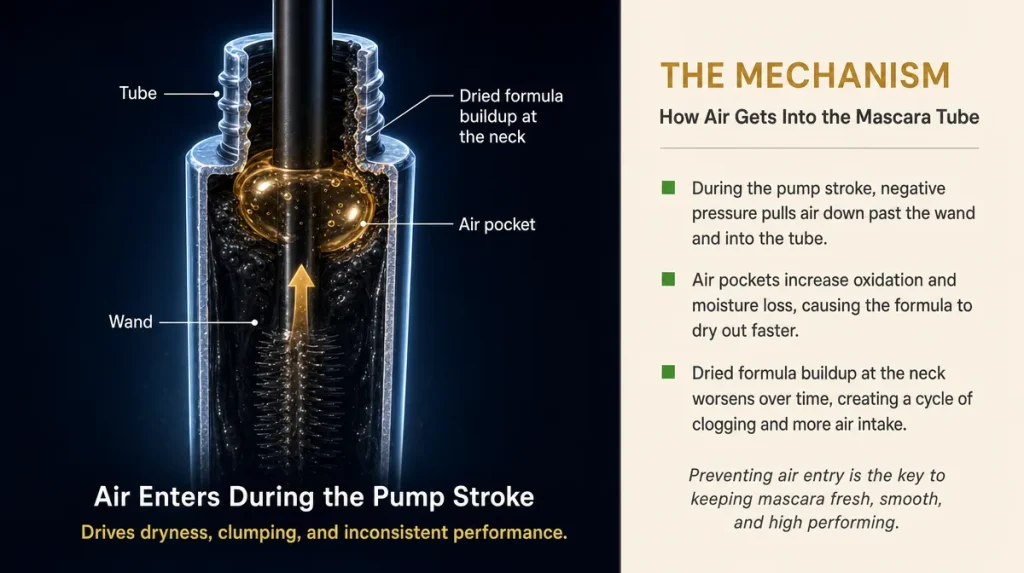
Almost everyone does this without noticing: wand out, a few quick pumps back into the tube to load up more product, wand back out. It feels like it should help. It does the opposite.
Every pump pushes a small amount of air down into the tube. Air dries formula the same way leaving a paint can lid loose overnight leaves a skin on top of the paint. Do this daily and the mascara inside thickens and clumps long before the three-month mark most dermatologists point to for hygiene reasons.
The fix is almost too simple: twist the wand out slowly, let any excess drip back down the shaft, and stop pumping. If the wand looks dry, swirl it once inside the tube rather than pumping. Wipe the tip against the inner rim, not against a tissue, to remove clumps without stripping the wand of formula it needs.
Self-test: before you apply, look at the base of the bristles. A ring of dried, flaky buildup there means the formula has been getting more air than product for a while, and no amount of careful brushing will make those lashes look freshly volumized.
The Two-coat Rule And Why A Third Pass Backfires
Volumizing formulas build thickness by coating each lash in layers, but only if each layer gets a chance to set before the next one goes on. Apply a second coat while the first is still wet and the fibers in the formula stick to each other instead of to the lash, which is exactly how spidery clumps form.
Drying time depends on the room. In a humid bathroom after a shower, or during a sticky East Coast summer, mascara can take closer to thirty seconds to set. In a dry, heated apartment in January, it can be closer to fifteen.
The method that actually builds volume: apply the first coat from root to tip in a light zigzag motion, wait, then apply a second coat focused mostly on the tips, where volume reads most visibly. Skip the temptation for a third full coat. If lashes look thin after two, add product only at the tips with the very end of the wand.
Self-test: touch a lash tip lightly with a clean finger about fifteen seconds after the first coat. If product transfers, wait longer before coat two. If it does not, you are clear to layer.
Curl Before You Coat, Not After
Curling lashes after mascara is already on them is one of the more damaging habits in a routine, and it is common because it feels like a touch-up. It is not. Once mascara has dried, the lash shaft is coated in a stiff film, and bending stiff, coated hair is more likely to snap than bending clean keratin. It also means product from your lashes ends up on the curler pad instead.
The more reliable sequence is curl first, on completely bare lashes, holding gentle pressure at the base for about ten seconds, then repeating at mid-length and near the tips for a softer, more natural curve rather than one sharp bend. Only then reach for mascara.
If lashes tend to drop by midday, a heated lash curler used briefly on bare lashes before mascara holds curl longer than mechanical curling alone, particularly in humid weather when a curl relaxes fastest.
Mistake to watch for: curling with cold metal in a cold bathroom, which is more likely to pinch and break lashes than curl them cleanly. Warm the curler briefly in your palm first.
The Heavy Hand On Lower Lashes
Volumizing formulas are built to be rich, and a rich formula applied heavily to lower lashes is the most common cause of the smudged, raccoon look under the eyes by afternoon. Lower lashes sit closer to the oil glands along the lower lid, and blinking presses them against the skin far more than upper lashes press against the brow bone.
The practical fix is to use noticeably less product on the bottom than the top. Turn the wand vertically and use just the tip, or the narrow point of the brush if the wand tapers, for a single light pass rather than a full sweep. One coat is almost always enough on the lower lash line, even when two full coats are right for the top.
In humid months, or if you know you run warm, consider skipping lower lash mascara on days that involve a lot of time outside, and relying on the upper lash volume alone, since that is what reads first from a distance anyway.
Mistake to watch for: applying lower lash mascara last, after the upper coats have already started transferring slightly to the under-eye from blinking. Do the lower lashes first, before the upper lash formula has a chance to migrate.
How Long Volumized Lashes Actually Last, And How To Judge Results Fairly
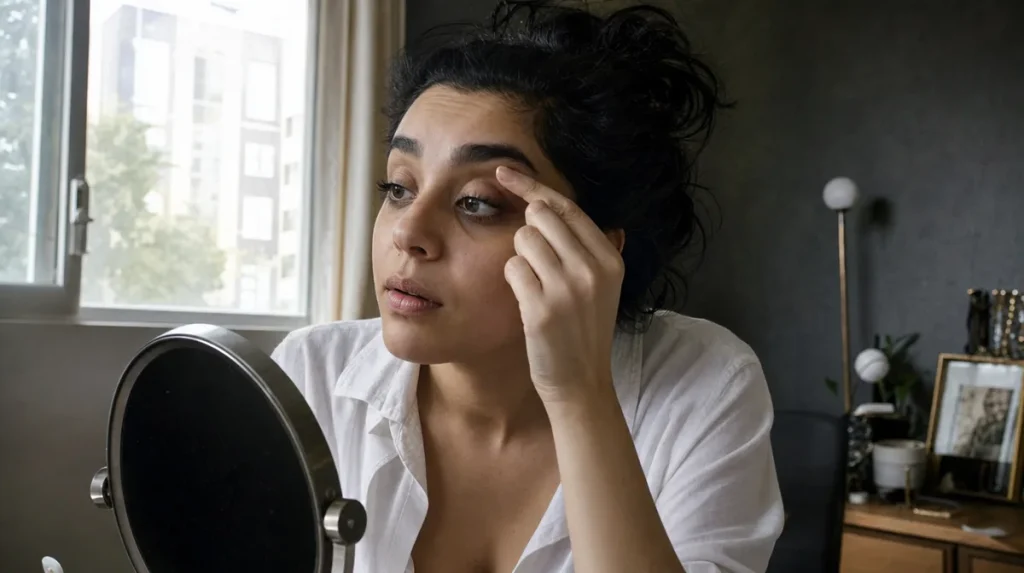
Judging a mascara the moment it goes on is not a fair test. Most formulas continue to bond and finish setting for close to an hour after application, and the honest read on volume, hold, and flaking comes later in the day, not at the mirror.
Climate changes the timeline more than most people expect. In a humid summer, expect flaking at the inner corner first, usually within a few hours. In a dry winter with indoor heating running constantly, lashes are more likely to feel brittle by evening rather than flake, since the same dry air pulling moisture from skin pulls it from lash hair too.
A fair self-test: check your lash line under bright daylight, not bathroom light, around the middle of the afternoon. Look specifically at the inner corner and the lower lash line, the two spots that show wear first. If those areas hold up, the rest almost always does.
What matters here is less the brand’s claim about hour-long wear and more your own repeated observation over a few uses, since the same formula behaves differently in July than it does in January.
Taking It Off Without Taking Your Lashes With It
Removal is where a lot of quietly accumulated lash damage happens, and it rarely gets blamed because the mascara itself looked fine going on. Rubbing at mascara with a dry washcloth or a fingertip creates repeated mechanical stress on the lash follicle. A 2023 study in the Journal of Cosmetic Science looked at that kind of repeated friction and linked it to increased lash shedding over weeks of daily wear, separate from any effect of the mascara formula itself.
The gentler method: soak a cotton pad with a dedicated eye makeup remover, oil-based for waterproof formulas and a gentler micellar water for regular ones, and hold it against closed lashes for about ten seconds before wiping down and away in one motion. Avoid side-to-side scrubbing entirely.
Mistake to watch for: skipping remover altogether and relying on a cleansing cloth or an all-in-one face wipe, which usually is not formulated to break down waterproof polymers and ends up requiring more scrubbing to get clean, which is the opposite of gentle.
The Three-month Rule, And Why Old Mascara Underperforms Before It Looks Spoiled
The American Academy of Dermatology’s public guidance on eye makeup hygiene points to replacing mascara roughly every three months, largely because the tube’s dark, moist environment is a comfortable place for bacteria to grow, a real concern for anyone who wears contact lenses or has sensitive eyes.
What is less discussed is that the formula stops performing well before that hygiene window becomes a real risk. Repeated pumping, temperature swings, and simple evaporation thicken the product gradually, so the volumizing effect fades in small increments that are easy to miss day to day. By month two, a formula that looked rich and buildable in week one often needs real effort to apply evenly.
Storage habits speed this up. A tube left in a hot car, a steamy shower caddy, or a bathroom with no ventilation ages faster than one kept capped tightly in a drawer at room temperature. If you notice a tube pulling at lashes or drying out mid-application well before three months, storage conditions are the likely reason, not a manufacturing flaw.
What Is Real Volumizing Chemistry, And What Is Just Label Language
Volumizing formulas typically add thickness through polymers and sometimes short fibers that build up along the lash shaft, coat by coat, in a way that is measurable, if modest, under close inspection. That mechanism is real. Claims like dramatic multiples of volume printed on packaging are marketing language and are not independently verified the way lab-tested claims from an outlet like the Good Housekeeping Institute typically are for the products it evaluates.
A more useful comparison is to a thickening shampoo: it can genuinely add a small amount of measurable diameter to each hair strand, but nowhere near what a bold claim on the bottle might suggest. Volumizing mascara works on the same modest, real scale.
What tends to matter more for the average person than any fiber claim is brush geometry: a densely packed, slightly curved brush distributes product more evenly across more lashes than a claim about ingredients does. Waterproof performance is another area worth testing yourself rather than trusting the label, since actual wear through a humid commute or a workout tells you more than the word printed on the tube.
Key Takeaways
Volumizing mascara mostly fails for procedural reasons, not formula reasons: too much air from pumping, too little patience between coats, curling after the mascara is already set, and a heavy hand on lower lashes that shows up as smudging later in the day. Judge results in the afternoon under real daylight, not at the mirror right after application, and give the same formula a fair chance across more than one season before deciding it does not work for you.
A Quick Checklist Before Your Next Application
- Stop pumping the wand; twist it out slowly instead
- Wait about fifteen to thirty seconds between coats, depending on humidity
- Curl lashes before mascara, never after
- Use noticeably less product on lower lashes than upper
- Check results in bright daylight in the afternoon, not right after applying
- Remove with a dedicated remover, holding rather than scrubbing
- Replace the tube roughly every three months, sooner if stored somewhere hot or humid
This guide offers general information and is not a substitute for personalized advice from a dermatologist.
Individual results vary depending on lash type, climate, and application habits.